944 S2 Valve Spring Inspection - My Discussion w/Gemini
Posted: Tue Jun 16, 2026 11:16 am
I've been having a disussiion with Google Gemini regarding the engine in my 16V S2. Specifically, I asked if I should be concerned about potential valve spring breakage since my engine has 155,000 miles and I recently saw a video about an S2 engine that dropped a valve due to broken valve springs. Not a pretty picture! I told Gemini that I had the tooling to pull the cams and was considering inspecting the springs.
Gemini said there wasn' an exact "time-bomb" mileage where the springs are guaranteed to fail but the general consensus among well-known Porsche specialists is failure of the inner valve springs typically begin to crop up in the 120,000-140,000 mile range. The risk is the inner spring handles a significant amount of the valvetrain load and when it breaks it can cause the valve to float at higher rpm, or in a worst case scenario, allow the valve to drop, leading to catastrophic piston to valve contact.
"While You're in There" dilemma: given the labor to inspect the springs and knowing the mileage, Gemini said to consider proactively replacing the springs, which can be done with the cylinder head on. The AI also asked about the status of the timing chain, which in my case is original (I have a new one, and new lifters too). Failure of the chain is just as bad as dropping a valve. I told the AI that my S2 does not get driven regularly. It can sit for a month or more sometimes, especially during the "dark ages" in Seattle. This in itself is not a good thing because the valve springs can experience static fatigue if the engine rests with certain valves fully open for extended periods.
Of course, another "while you'r in there" would be to change the valve stem seals. I then asked about the guides. Gemini said if the guides are worn, which they probably are to some extent, the valves can wobble and more quickly wear out new valve stem seals.
The AI then asked if the head gasket was original, which it is. It said the fact that I have a factory-original head gasket that's 36 years old and has experienced some track days (20 years ago... I've had the car for 29), means the head gasket could be a bigger ticking time bomb than the valve springs. It said head gaskets degrade from heat cycling and time just as much as mileage. The composite material breaks down, and the sealing rings around the coolant passages become brittle.
Pulling the head to replace the gasket means the top end would get a complete refresh and should be good for another few decades.
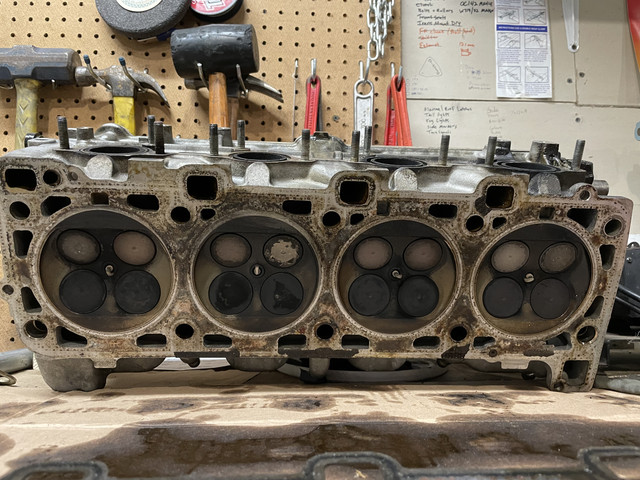
The engine in my S2 runs as good as it did 29 years ago and uses next to no oil between changes. However, I know the cam chain is old and should be replaced, and I know the valve springs can be an issue with the 16V S2, so I'm kinda leaning towards pulling the head and doing a complete refresh as i'd like to hand this car down to one of my sons or grandsons (or granddaughters if so inclined, ha, ha).
The engine is really the only thing that hasn't been updated in the last 29 years. Any thoughts from the engine experts in the group would be appreciated. For instance, are there other options than Porsche valve springs? Would you pull the head or let "sleeping dogs lie?" Thanks in advance.
Gemini said there wasn' an exact "time-bomb" mileage where the springs are guaranteed to fail but the general consensus among well-known Porsche specialists is failure of the inner valve springs typically begin to crop up in the 120,000-140,000 mile range. The risk is the inner spring handles a significant amount of the valvetrain load and when it breaks it can cause the valve to float at higher rpm, or in a worst case scenario, allow the valve to drop, leading to catastrophic piston to valve contact.
"While You're in There" dilemma: given the labor to inspect the springs and knowing the mileage, Gemini said to consider proactively replacing the springs, which can be done with the cylinder head on. The AI also asked about the status of the timing chain, which in my case is original (I have a new one, and new lifters too). Failure of the chain is just as bad as dropping a valve. I told the AI that my S2 does not get driven regularly. It can sit for a month or more sometimes, especially during the "dark ages" in Seattle. This in itself is not a good thing because the valve springs can experience static fatigue if the engine rests with certain valves fully open for extended periods.
Of course, another "while you'r in there" would be to change the valve stem seals. I then asked about the guides. Gemini said if the guides are worn, which they probably are to some extent, the valves can wobble and more quickly wear out new valve stem seals.
The AI then asked if the head gasket was original, which it is. It said the fact that I have a factory-original head gasket that's 36 years old and has experienced some track days (20 years ago... I've had the car for 29), means the head gasket could be a bigger ticking time bomb than the valve springs. It said head gaskets degrade from heat cycling and time just as much as mileage. The composite material breaks down, and the sealing rings around the coolant passages become brittle.
Pulling the head to replace the gasket means the top end would get a complete refresh and should be good for another few decades.
The engine in my S2 runs as good as it did 29 years ago and uses next to no oil between changes. However, I know the cam chain is old and should be replaced, and I know the valve springs can be an issue with the 16V S2, so I'm kinda leaning towards pulling the head and doing a complete refresh as i'd like to hand this car down to one of my sons or grandsons (or granddaughters if so inclined, ha, ha).
The engine is really the only thing that hasn't been updated in the last 29 years. Any thoughts from the engine experts in the group would be appreciated. For instance, are there other options than Porsche valve springs? Would you pull the head or let "sleeping dogs lie?" Thanks in advance.