


944 DME Relay Bypass -- Why Won't my 944 Start?
If your Porsche 944 cranks but won’t start, one of the first things to try is bypassing the DME relay as shown below. The DME relays are electro-mechanical devices that can and do fail, especially now that most originals are around 40 years old. They are generally considered the number one cause of no-starts on the 944.
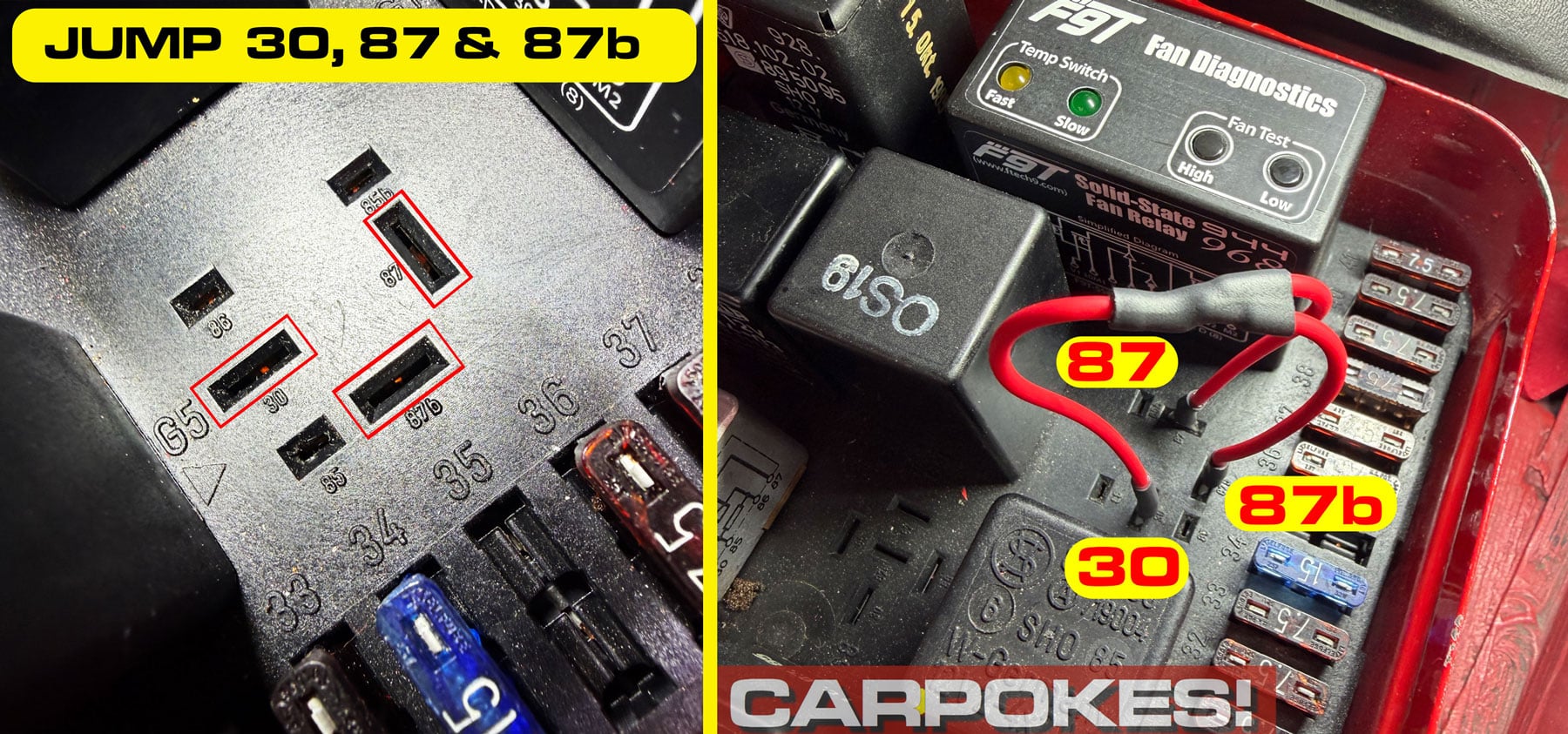
Quick answer: If your Porsche 944 starts with the DME relay bypass jumper installed (30, 87, and 87b), the relay is most likely bad.
Assessing Results Car starts with jumper: If your no-start 944 fires right up with the bypass jumper installed, the DME relay is most likely bad and should be repaired or replaced. Some people have success re-soldering the internal connections. Others don’t.
If the car starts when the DME bypass is installed, that does not guarantee the relay is bad — only that it is highly likely. To confirm with certainty, you would need to bench test the relay, try a known-good relay, or test the remaining relay socket terminals as described below. Still no-start: If the car still does not start with the jumper installed, something other than the relay is preventing it from starting. The relay may still be bad, but another issue is also present.
Before moving on, confirm that terminal 30 has battery voltage. If socket terminal 30 has no power, the jumper will not work and the issue is upstream of the relay. Starts with jumper but not with a known-good relay: If the car starts with the jumper, but not with a known-good relay, the problem is likely in the relay control circuit.
First, check whether terminal 86 in the relay socket is getting 12 volts (battery voltage) when the ignition key is turned on. If terminal 86 is not getting power, the ignition switch, a faulty alarm system, or related wiring is the likely cause.
If terminal 86 has power and the car runs on the jumper but still does not run with a known-good relay, check whether the DME is providing ground to terminal 85b while cranking the engine.
Terminal 85b should be grounded by the DME (pin 20) to energize the fuel pump side of the relay. The fuel pump only runs when the DME sees engine rotation and shuts off if the engine stops. This is a safety feature that prevents fuel from pumping after a major accident. When jumpered, this safety feature is disabled, so use caution and only keep the jumper installed as long as necessary to test and/or to move the car to a safe area.
Note: Many sources incorrectly state that terminal 85 is grounded by the DME. In fact, terminal 85 is hard-wired to ground via chassis ground point MP III.
Assessing Results Car starts with jumper: If your no-start 944 fires right up with the bypass jumper installed, the DME relay is most likely bad and should be repaired or replaced. Some people have success re-soldering the internal connections. Others don’t.
If the car starts when the DME bypass is installed, that does not guarantee the relay is bad — only that it is highly likely. To confirm with certainty, you would need to bench test the relay, try a known-good relay, or test the remaining relay socket terminals as described below. Still no-start: If the car still does not start with the jumper installed, something other than the relay is preventing it from starting. The relay may still be bad, but another issue is also present.
Before moving on, confirm that terminal 30 has battery voltage. If socket terminal 30 has no power, the jumper will not work and the issue is upstream of the relay. Starts with jumper but not with a known-good relay: If the car starts with the jumper, but not with a known-good relay, the problem is likely in the relay control circuit.
First, check whether terminal 86 in the relay socket is getting 12 volts (battery voltage) when the ignition key is turned on. If terminal 86 is not getting power, the ignition switch, a faulty alarm system, or related wiring is the likely cause.
If terminal 86 has power and the car runs on the jumper but still does not run with a known-good relay, check whether the DME is providing ground to terminal 85b while cranking the engine.
Terminal 85b should be grounded by the DME (pin 20) to energize the fuel pump side of the relay. The fuel pump only runs when the DME sees engine rotation and shuts off if the engine stops. This is a safety feature that prevents fuel from pumping after a major accident. When jumpered, this safety feature is disabled, so use caution and only keep the jumper installed as long as necessary to test and/or to move the car to a safe area.
Note: Many sources incorrectly state that terminal 85 is grounded by the DME. In fact, terminal 85 is hard-wired to ground via chassis ground point MP III.
How to Do the Bypass Test
Follow these steps to bypass the DME relay and test a crank-but-no-start condition.
-
Locate the DME relay in the fuse/relay panel. On early cars, it is under the steering wheel area. On later (1985.5+) cars, it is in the engine bay under a black plastic cover near the windshield on the (U.S.) driver side.
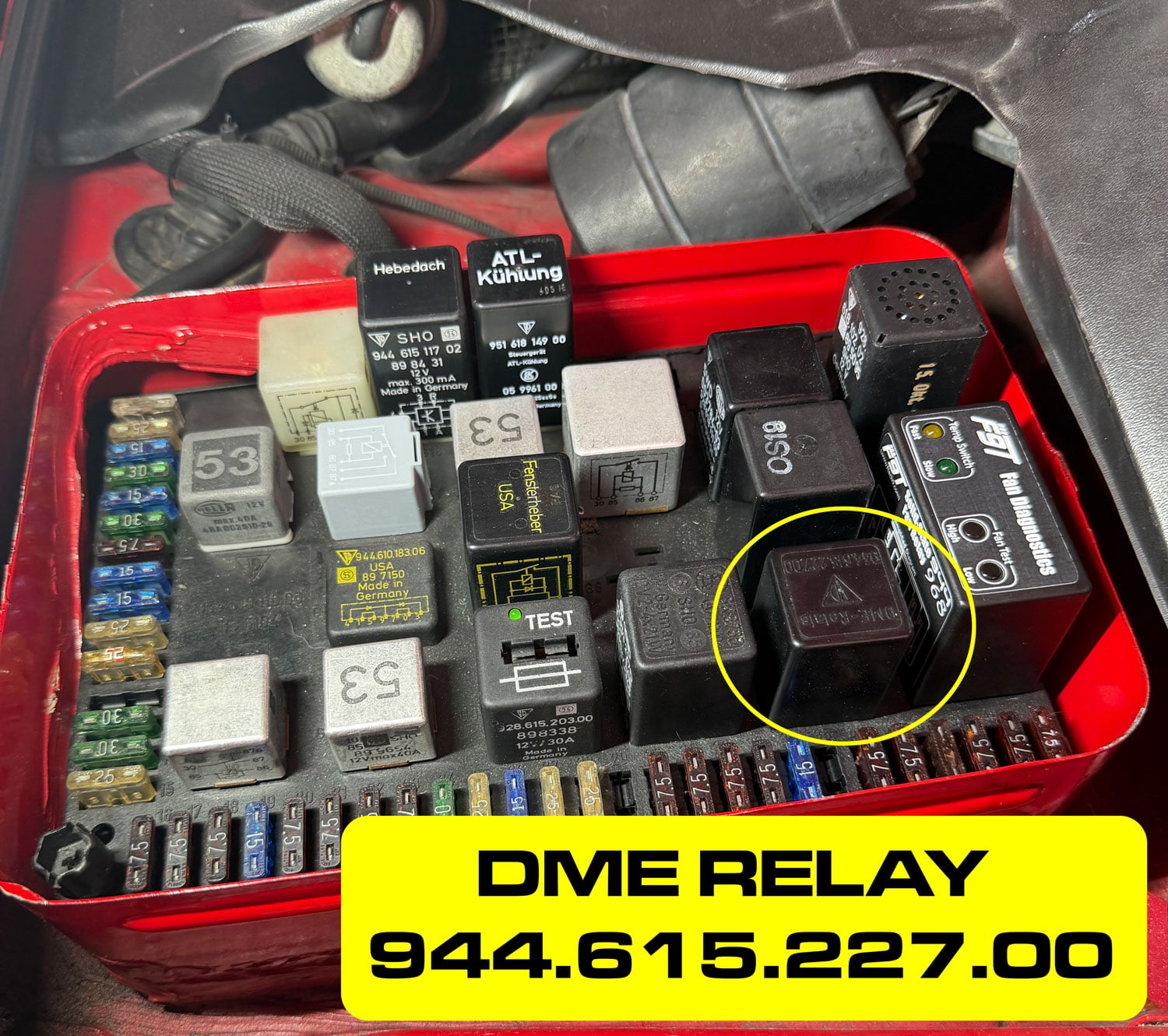
- Remove the relay by wiggling gently and pulling straight up.
- Identify terminals 30, 87, and 87b. These terminals are easy to spot (and remember when stuck on the side of the road) because they are the only 3 wide slots in the socket. See picture at the top of this page.
-
Make a jumper wire using standard (wide) spade connectors and thick wire (18 gauge minimum for quick testing, 14 gauge or bigger for emergency driving while jumpered).

- Install the jumper connecting 30, 87, and 87b, as shown above. Keep in mind that terminal 30 is a live 12-volt feed directly from the battery, so it’s best to connect that leg last and remove it first to avoid accidentally shorting it to ground with the other jumper leads. You could even add an inline fuse to the terminal-30 wire if you wanted to be extra careful. Either way, just remember you are working with an always-hot 12-volt source, so take your time and be mindful — a slip can easily cause sparks, damage, or worse.
- Try to start the engine.
- Remove the jumper after testing.
Emergency Roadside Patch (Temporary Only)
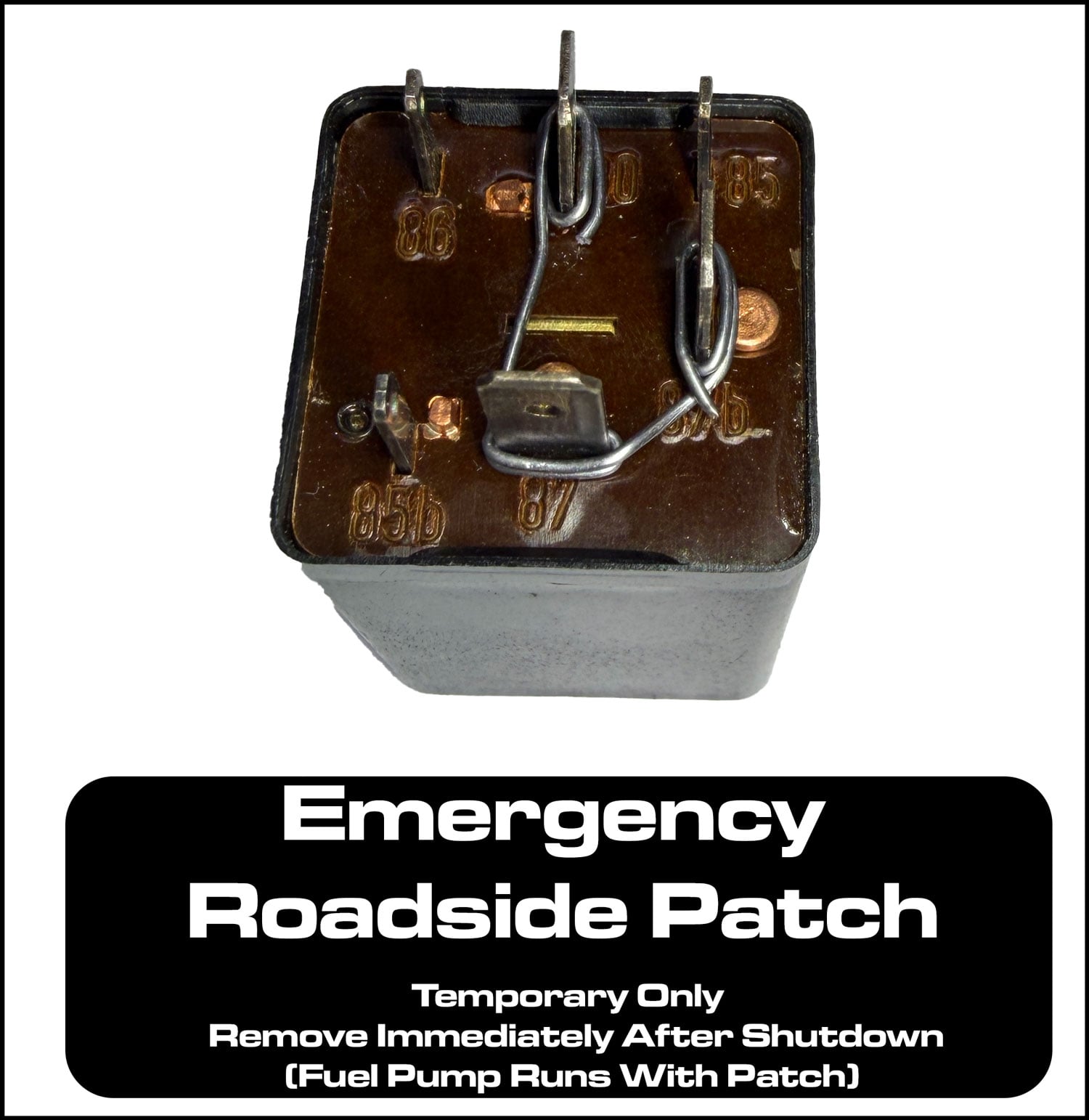
If your car is stuck in an unsafe location and you suspect the DME relay, you can remove it and short terminals 30, 87, and 87b as shown with a short length of wire, paper clip, hair clip, or whatever you can find. Keep in mind that the system is drawing a significant amount of current, so ideally you want to use something equivelent to gauge 14 wire or better, especially if you plan to keep the relay installed this way for more than a quick test. After reinstalling the relay with a shorting wire, this may allow you to move the car to a safer location.
This is effectively the same as installing the jumper shown above, so the same precautions apply.
Remove the shorted relay immediately after shutting off the engine, otherwise the fuel pump will continue to run. Also understand that, like the bypass above, this defeats the normal fuel-pump shutoff safety feature in the event of an accident.